Wednesday, May 7, 2014

Arrivederci, Roma

Salve, amici. Well, it's been almost three weeks since I left Rome. Can you believe it? (I certainly can't.) I haven't posted for a while because a) I've been traveling and it's been VERY busy and b) it's been hard to bring myself to write this farewell message. Farewell to Rome, not to you; I've got lots to write before I throw in the towel completely. But my time in Italy is over. (Actually, though: My visa has expired and I cannot return for another ninety days.)

On my last day in the city, I did what I'd avoided for the past several months of living there: I became a tourist again. Most of the SMC girls had left that morning for home or whatever their interim destinations were. The sun was shining and - as my friends are sick of hearing me say - there is nothing more beautiful than Rome when the sky is blue. A light seems to radiate from the buildings themselves, reflecting the sunshine with a kind of warmth that is so different from the cold, steely light of most modern cities. The organic stone of church domes and monuments against blue sky is breathtaking, and on this day - April 16 - Rome had never been lovelier. Even the pollution-clogged Tiber sparkled a pretty green as I set out across town to take some final photographs and visit one of the final archaeological sites on my to-do list: the Baths of Caracalla.

The Tiber and Castel Sant'Angelo

But first, I went over to Saint Peter's Square one last time to mail some postcards and take some photos of the magnificent cupola outlined against the sky. I visited my favorite café to say goodbye to Alam (the worker who was always there) and order one last juice. I ate a final supplì (a delicious fried rice ball filled with cheese and tomato sauce) and wandered through the Jewish Ghetto, the Forum Boarium, and the Circus Maximus on my way to the Baths. I'd written a report on these Baths during the fall semester, and I was determined to actually see them before leaving. When I got there, I was thrilled to see just how spectacular they are.

Last glance at Saint Peter's

The Baths are enormous, for one thing: They were two storeys and over thirty-eight meters tall (thats about 125 feet). In addition to enormous pools for bathing and wading, there were palaestrae (exercise courts), libraries, spas, shops, and changing rooms. The decorations would have been elaborate: Mosaic floors, massive sculptures (some of which survive), expensive marbles, and trickling fountains made this an experience of luxury for the everyman (and some women, too!) in ancient Rome. Today, you can still get a feel of their enormousness and opulence, and I felt like a little kid on a playground as I wandered open-mouthed through the halls.

The Baths at last

After visiting the Baths, I walked slowly back through the Ancient City one last time, skirting the Palatine, swinging past the Colosseum and the Arch of Constantine, passing through the ancient Fora and in front of the Vittorio Emanuele monument in Piazza Venezia, and taking a few last-minute pictures of the victory temples in Largo Argentina. Then I joined the other two remaining Smicks for a final Italian dinner, glass of wine, and scoop of gelato...and one last adoring look at the Pantheon, my favorite building in the world.

Early the next day, my cab driver took extra care to pass the Ancient City in the morning moonlight so I could see it one last time before I boarded a train and then a plane out of Italy.


Colosseum for the last time

For all my efforts, it is a hard place to describe and even harder to understand. Regarding Italy, my professor (who is himself Italian) once said, "It is an absurd country, in many respects." And it is. The ever-famous Rick Steves said that Rome is "brutal and beautiful." And it is. But my favorite quote describing Rome - because it is entirely true for me - is the following: "Rome will make you fall in love with itself slowly but forever."

I came to Rome expecting what I'd spent the last six years learning and dreaming about in Latin class: a magical, mythical mix of ancient and modern; a land flowing with olive oil and tomato sauce. I came expecting to be delighted by all there was to learn and thrilled by the exoticism of a foreign country. I expected Italian to come effortlessly after a few weeks of "immersion." I wasn't prepared for the noise, the traffic, the pollution, the crowds, the smoky air, the shattering bottles at two in the morning, the pushy salesmen, the blaring car horns...the fact that Rome was a city, a very living, very messy city with terrible WiFi and abysmal mail service. I wasn't expecting to be pushed and pulled and challenged and transformed so quickly or in the ways that I was. In the beginning, it was scary, and loud, and uncomfortable, and unfamiliar, and totally overwhelming. In the beginning, I wasn't sure I'd be able to handle seven months of it.


Last gelato, wearing the same jacket in the same gelateria as my first gelato

But then, ever so slowly, my expectations and preconceptions about Rome were peeled away, and I was able to see the city for what it was. I stopped waiting for something else to arrive and started noticing and accepting and enjoying what was actually around me. And when I was able to do that, I began to fall in love with it. And in addition to the city itself, the country as a whole, and its people. It was a love story that was bound to happen, just not the way I expected. 

So, in addition to all that I'm still learning, that is one of the major lessons I took from La Città Eterna: honesty. I had to learn to be honest with myself and abandon what I'd expected to be true for what actually was true. I had to learn to accept what was present instead of vaguely chasing the way I thought it would or should be. And in exchange, I found something so much deeper, so much more meaningful, and so much more beautiful in Rome - and maybe even within myself as well - than I would have if it had been what I'd expected. I found a world of wonderful people, beautiful vistas, delicious flavors, vibrant colors, passionate songs, and thrilling stories. Rome was where I came alive in a brand new way.

As I said through tears in my final Italian class, Roma era il mio sogno. Rome was my dream. Now it is a home as well, for in a way it has become a friend that engaged me and thrilled me with its adventures and comforted me during times of loneliness and loss. It is a place I had to learn to love, in spite of its disastrous government, disappointing public transport, and life-threatening Vespas. I made friends and memories and progress there. Signor Bruno and Signora Patrizia, who looked out for us; Patrizio, who teased us; Stefano, who held my hand when my grandma died; Aldo, who'd talk to us for hours; all of my professors, who taught us about things that mattered. They made Rome home. And that will always mean the world to me. 

I don't know when I will return to Rome, but I know now that I have to. It has too much of my heart for me to stay away, and I'm sure anyone who's spent any prolonged amount of time there can understand. And I am so, so grateful for the time I spent there, the lessons I learned, and the people I met. I'm grateful for everyone who made this dream come true for me, at home and abroad. And I'm grateful to you, for caring enough to go on this journey with me.

So in the words of Dean Martin: Arrivederci, Roma. Grazie per tutto, e ci vediamo...presto. :)


The view from my window

Tuesday, April 15, 2014

Gelato jubilee

Ciao, amici. It is impossible to believe, but I am officially days away from my departure from Rome. My mind truly cannot comprehend this fact - I think denial is one of the stages of grief, isn't it? - but nonetheless, I am making preparations for the fateful day. To be honest, I can't even begin to form words for the occasion. Leaving Rome still seems like the abstract, faraway concept it has been for the past several months.

HOWEVER, I do recognize that - as we conclude the feast of life that this study-abroad experience has been - there needs to be some reference to the all-important dessert. And when in Italy, one dessert is king: ice cream, or gelato.


Gelato is a gift to humanity that has become a necessity for living, rather like technology or modern medicine. The creaminess, the flavor combinations, the sweetness. Superior to regular ice cream in ways that can't be fully described or understood. It's creamier than regular ice cream, but it's not like custard or soft serv. It's not as icy - or healthy - as fro yo. Forgive me for failing to provide an accurate description, but just trust me: Gelato is king. 

Judging gelato is a journey, no joke. I have taken it as my personal duty to sample as many different gelati and gelaterie (gelato shops) as possible throughout Italy, but especially in Rome. It is impossible to find one universal favorite among locals, tourists, students, or even experts: Each gelateria has its own quirks, its own flare, and its own flavors. Therefore, in compiling my top ten, a great deal of the ordering is based purely on personal opinion, taking quality, originality, cost, and location into consideration. I have found that most people agree with my choices (if not necessarily the order itself). So HERE IT (FINALLY) IS:

JENNIFER'S TOP TEN GELATERIE:
1. Frigidarium
2. Giolitti
3. Fassi
4. Old Bridge
5. Flor
6. Della Palma
7. Sweety
8. Punto
9. San Crispino
10. Grom

THE CRITERIA:
1. Quality (ranges from "Good" to "High" to "Very high")
2. Originality
3. Cost
4. Location (how easy it is to include it in one's travels)

1. Frigidarium
Quality: High (good combination of regular and unique flavors; ultra-creamy)
Originality: Cones and cups come dipped in white chocolate, dark chocolate, or cream, and the signature flavor is out of this world; pleasant student-friendly ambience
Cost: Excellent - a small cup or cone (2 flavors) is EUR 2
Location: A bit hard to find but very centrally located near Piazza Navona and Corso Vittorio Emanuele

2. Giolitti
Quality: Very high (great assortment of flavors and whipped cream on top)
Originality: One of the most popular in Rome, pleasant old-fashioned style
Cost: Reasonable - a small cup or cone (2 flavors) is EUR 2.50
Location: A bit tucked away but centrally located near the Pantheon and the Column of Marcus Aurelius

3. Fassi
Quality: High (great flavors, good texture)
Originality: Supposedly the first in Rome, very popular with the locals
Cost: Unbeatable - a small cup or cone (3 flavors) is EUR 1.60

Location: Not centrally located - southwest of Termini Station - but worth the trip

4. Old Bridge
Quality: High (creamy texture, good combination of usual flavors and unique ones)
Originality: Nothing terribly new but just good, basic gelato
Cost: Excellent - a small cup or cone (2 flavors) is EUR 2

Location: Two nice locations, one in Trastevere and one near the Vatican Museums

5. Flor
Quality: High (good combination of classic and adventurous flavors)
Originality: It's a pretty well-regarded chain, but it also offers some other cool desserts
Cost: Reasonable - a small cup or cone (2 flavors) is EUR 2.50
Location: Excellent - the one closest to me is right on Campo de' Fiori

6. Della Palma
Quality: Good (lots of flavors, well-made)
Originality: Over a hundred flavors of gelato, sorbetto, and mousse, including dairy-free options
Cost: Reasonable - a small cup or cone (2 flavors ) is EUR 2.50
Location: Just behind the Pantheon square

7. Sweety
Quality: Good (different flavors of self-service with lots of toppings)
Originality: One of (if not THE) first fro-yo-like gelaterie in Rome (like Milwaukee's Yo Mama or South Bend's Let's Spoon); hugely popular with young Italians
Cost: Depends on how much you get; it's all by weight, so it's pretty reasonable

Location: Excellent - right by Campo de' Fiori

8. Punto
Quality: High (excellent white-chocolate raspberry flavor)
Originality: Lots of unique flavors (like "pine"), plus other desserts like semifreddo
Cost: Reasonable - a small cup or cone (2 flavors) is EUR 2.50
Location: Decent - close to the river, between Campo de' Fiori and Trastevere.

9. San Crispino
Quality: Very high (no artificial colors or anything, but I was very disappointed my vanilla bourbon flavor)
Originality: One of the more "artisan" gelaterie in Rome
Cost: Expensive - a small cup or cone (2 flavors) is EUR 3.50
Location: Just behind the Pantheon square

10. Grom
Quality: Good (popular chain all over Italy; a bit icy but reliably good)
Originality: Flavors of the month fluctuate, plus other standard flavors
Cost: Reasonable - a small cup or cone (2 flavors) is EUR 2.50
Location: They're everywhere

So the next time you're in Rome, looking to indulge in something dolce, I insist you check out at least one - preferably more - of these fabulous gelato stops. Think of me when getting the Frigidarium flavor at Frigidarium - and stop for a Magner's at The Abbey Theatre across the street. For everyone who's been to Rome, let me know what your favorite gelato experience was! 


Because gelato is more than a dessert. It's a way of life. And a pretty sweet one, too. 

My first gelato in Rome (sniff)

Sunday, April 13, 2014

Split down the middle: A weekend in Europe's hidden masterpiece

Sixteen hours of busing. Three countries. Three days. Why? Our trip to Croatia, of course!

Five of my friends and I boarded a coach bus last Thursday evening with twenty-five other American students for a long weekend in one of Europe's least-discovered - but fast-growing - destinations: the beautiful city of Split on Croatia's pristine Dalmatian coast. It's almost a straight shot eastward from Rome, but due to the minor presence of the Adriatic Sea, we instead curved northward through Florence and Venice and skirted the coast through Slovenia and Croatia. We booked the trip with the student-oriented tour company Bus2Alps and drove through the night, which could have been more comfortable but ended up being worth the cramped necks and un-stretched legs. Our hostel was less than two minutes' walk from the waterfront and in the heart of the historic center, so our excitement got the best of us and after a quick breakfast and change of clothes we headed out to explore.

Like much of Eastern Europe, especially in the Balkans, Croatia has a checkered history of occupation, leading to a very strange concept of cultural identity that almost seems to be lacking altogether. Like the rest of the Mediterranean, it was once part of the Roman Empire; in fact, the city of Split was built in and around the remains of the Roman emperor Diocletian's palace, who apparently enjoyed the natural splendor of the area as much as modern tourists do. The Austro-Hungarian Habsburg dynasty ruled beginning in the 16th century; it then became part of the Kingdom of Yugoslavia during World War I, was established as a fascist puppet state during World War II, and eventually seceded from Second Yugoslavia, declaring independence in 1991. Therefore, it's a unique blend of Mediterranean culture - shared by countries like Italy and Spain - and Eastern European; we saw almost as much Italian as we saw English on menus and signs, and most restaurants offered seafood and Italian cuisine.

Friday, after our arrival, we headed to Diocletian's Palace and explored the unique conglomeration of ancient ruins and modern enterprise that it has become; truly, the city has developed itself within and around it. We explored nearby markets and enjoyed a delicious Italian-influenced lunch - reveling in the great exchange rate between the euro and the Croatian kuna - before exploring the remaining lower levels of the Palace. Mold and moss grew in abundance on the damp brick walls, but the structure remained remarkably intact; but for the presence of some suspiciously foreboding pigeons, it was a pleasant trip to the ancient Mediterranean outside the "usual" Roman fare.

The inside of Diocletian's Palace, which has been filled with shops and restaurants in addition to ruins

One of the ancient ceilings of the Palace's lower levels, covered in green moss!

We rested that afternoon, still recovering from our fractured night's sleep, and ventured out for more Italian-inspired food for dinner. The next morning we got up to explore the beautiful vista from atop the hill in a nearby park, where we enjoyed spectacular views of the city and the sea. Behind the flat coastal plain on which Split was sprawled, long ranges of rocky mountains stretched parallel to the shoreline; it was rugged and looked remarkably untouched, unlike the hills and mountains of Italy which - though lovely in their own right - are always dotted with towns and farms. We didn't have long to spend in the park, for we had to return to the city center to catch a ferry for our island hopping tour with Bus2Alps.

Beautiful Split, with the sea on one side and the mountains on the other

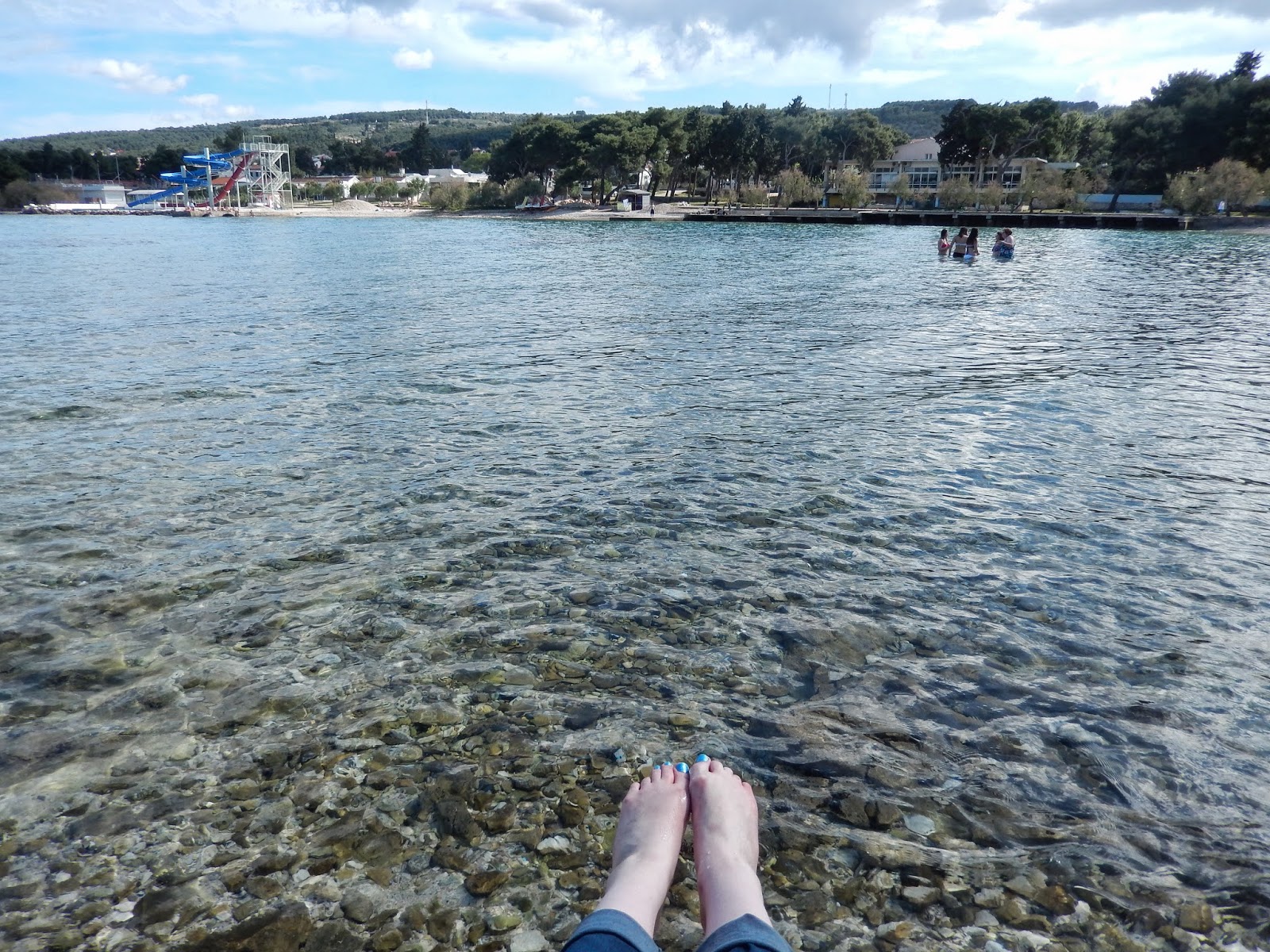
The Croatian seaboard is dotted with hundreds of islands, and we visited two villages on one of the largest: Brač (rhymes with "watch"). We were treated to a gorgeously sunny day, and the water glowed aquamarine as we sailed and beached on the Adriatic. The water was crystal clear - so transparent that we could count the rocks at the bottom and see the shadows of docked boats on the seafloor - but also outrageously cold. Nevertheless, with a little encouragement from my friends, I put on my swimsuit and waded in for a few frigid but exhilarating minutes. The view could not have been more spectacular, with the azure skies, rolling mountains, and charming village in the backdrop. The chaos of the past several weeks in Rome - preparing for finals and the approaching departure from Italy - melted away for a few delightful hours, leaving us refreshed and relaxed by the soothing beauty around us.

Split from offshore

The mainland from Brač

One of the villages on Brač

A harbor on Brač

Crystal clear water!

FREEZING (but worth it)

After another delicious Italian dinner, a brief nighttime stroll near the seashore, and some coffee and dessert near our hostel, we awoke the next morning and left Split with the rest of Bus2Alps for a few hours at Krka National Park. It is a protected stretch of mountains and woodlands surrounding the Krka River, famous for its magnificent waterfalls. Blessed with more sunshine, we spent our last kuna on figs - a traditional Croatian snack - and dipped our toes in the icy river water, trying (and failing) to take photographs that might have a hope of capturing the scope of the scene. Two of my friends decided to really get the full Croatian experience and fell spectacularly on the slippery river shore, which required a quick dip in the Krka to wash off the mud. We all wanted more time, but before we knew it we had to trek back up to the bus and begin the long drive back to Rome. Thankfully, it was largely uneventful except for a thrilling twenty-minute stop at border control between Croatia and Slovenia. We got our passports stamped and stood for fifteen glorious minutes on Slovenian soil before being shepherded back on board and continuing toward Rome, at which we arrived by 2:30 Monday morning.

Waterfalls at Krka National Park


Another set of falls on the River Krka

Excited to be in Slovenia!

It was a trip totally unlike the others I've taken this semester. It wasn't jam-packed with city exploration or sightseeing. There wasn't much of a new culture to embrace or new cuisine to try. (That's no insult against the Croatians, who are very pleasant people with a rich history and great food; there just wasn't much in terms of overt societal differences.) The magic and allure of Croatia is the land itself, which the people have been brilliant enough to leave largely in its natural state. The mountains, the beaches, the water, the greenery, the towns themselves were beyond photography (though I've included some here anyway). After so much intense learning and listening and seeing - all wonderful, all life-changing - Croatia was a place where we could just be, enjoy each other's company, and marvel at our surroundings without taking notes or memorizing dates. After visiting and being taught about some of the greatest triumphs to come from human hands, we now could witness just one of the beautiful corners of the world that no human could ever recreate.


Wednesday, April 2, 2014

"Caput mundi": Rome as a world city

Ciao, belli. Time is winding down for me in the Eternal City, as much as I'm trying to deny it; the semester ends officially in two weeks, and my departure from European soil is just over a month away. Nevertheless, I'm determined to keep sharing the magic of Rome as long as I can.

As you may or may not be aware, President Obama made the trip to Rome to visit Pope Francis, the Colosseum, the Italian President Giorgio Napolitano, and the new Italian Prime Minister Matteo Renzi. The weekend before, Rome had also hosted its annual marathon, which was attended by thousands from all over the world. Though it's known mainly for its monuments and as the capital of a nation globally endeared for its food and hospitality, Rome is still very much a living metropolis, alive with socio-political activity as well as cultural allure. The ancients called it "caput mundi" (head of the world) for a reason, and even today it holds onto much of its prestige and importance in the global spotlight.

Stationed at kilometer 37 of the Rome Marathon

Runner in a toga. Classically classic.

Rome is of course the seat of the Italian national government, which in spite of some severe political shortcomings - some still the indirect results of Fascism's dark entrance into Italian history - remains an important player on the European and world stage. Depending on how engaged you are with overseas affairs, you may have heard of a man named Silvio Berlusconi, media-mogul-turned-politician who's dominated Italian politics for over twenty years and is now under house arrest for tax fraud. If you're really current, you'll have heard of Italy's new "bulldozer" prime minister Matteo Renzi (appointed to office this past February!), formerly mayor of Florence and now the youngest P.M. since Italian unification in 1861. Though it hasn't affected me personally as an American student, Italian politics have been quite colicky these past few months; during the U.S. government shutdown, Italy faced its own shutdown when five cabinet ministers resigned under Berlusconi's orders (even though he's been evicted from the Senate) and almost caused a dissolution of Parliament. The ever-popular Berlusconi's friendship with Vladimir Putin, in spite of a history of supporting U.S. interests, has also seasoned Italy's perspective on the recent tensions with Russia; there were anti-U.S. government protests near the American Embassy in response to Obama's visit.

"Rome stands with Putin. Obama [is] an unwanted guest."

And as I'm sure you know, Rome is also the home of the Roman Catholic Church, whose political base is the Vatican City. Italians in general seem to be strongly culturally Catholic and not as spiritually devoted as I expected, but the presence of the Church is certainly a major one in Rome. Tens of thousands from all over the world flock to Saint Peter's Square every day - especially on Wednesdays for the general audiences and on Sundays for Mass - while thousands more crowd the impressive Vatican Museums in the meantime. All over the city, street vendors offer everything from bracelets to posters to flags to spoons with the Pope's face on it (or, recently, the two popes about to be canonized: John XXIII and John Paul II); rosaries and religious medals; icons, mini statues, and prayer cards; and my personal favorite: calendars of handsome priests instead of scantily-clad firemen. Every day I pass dozens of sisters, nuns, priests, deacons, and monks on the streets: some native Italians, others pilgrims from every continent, others seminarians or students like me. The Sunday after Easter this year, two enormously popular Catholics - Popes John XXII and John Paul II - will be canonized, an event during which Rome will be braced for an onslaught of millions of international devotees. At the risk of being spiritually punny, Rome is the Mecca of Catholicism, and its hundreds of churches and famous spiritual works testify to this.


The famous PopeMobile

Ciao, Papa!

Tens of thousands gather in Saint Peter's Square every time Papa Francesco appears

Rome's unique global importance culminated for me last week when within the span of about twenty-four hours I had been five feet from Pope Francis and a hundred fifty feet from President Obama. I was lucky enough to attend my second general audience with Papa Francesco - my fourth time seeing him in person - on that Wednesday, and the following day I was hanging out of the SMC library window to watch President Obama's motorcade zoom past on his way from the Vatican to the Colosseum. Dozens of people - Americans, Italians, and others - ran to watch POTUS wave out the window. It's interesting that the closest I have been - and may ever be - to an American president was in Italy. Che strano. 

Living in a world city - particularly this one - has been quite the experience. Marked with traffic, celebrities, politics, strikes, protests, demonstrations, and excitement, it's been a thrilling roller-coaster of activity since day one. Returning to the quiet American Midwest will surely be an adjustment, a relief, and a major letdown all in one. But until then, all I can do is revel in the noisy streets, the smoky city air, the flurry of shoppers and vendors and commuters, and the boundless opportunities for as long as I'm still here.


And lest you dare forget: SPQR!

Wednesday, March 26, 2014

What my grandmother taught me

Salve, amici. It's been too long, I know, but if New Yorkers think theirs is the city that never sleeps, I dare them to plan a trip to Rome.

As many of you probably know, I lost my lovely grandmother on March 10. She lived a full, beautiful life of 89 years, was an amazing mother to five, proudly bragged about her fifteen grandchildren, and was the loving spouse of a devoted husband (my grandpa) for over sixty years. Her passing was not so much a tragedy as the peaceful conclusion of a life well lived, but it has been with great sadness that I've slowly been coming to terms with the fact that one of my biggest fans and role models is no longer just a phone call away.


Losing a loved one while overseas is a very strange grief experience. On one hand, it is easy to be distracted from the initial pain of loss. But on the other, it takes a long time to adjust to the sadness because it is not always present, and so when it breaks through the distraction of your separated environment it is all the more difficult to face. And facing a family death without the physical presence of your family is not ideal, either. Nevertheless, in the past weeks I've been able to reflect on just what an amazing life my grandmother led and how I hope to be blessed with a fraction of the incredible memories and people she enjoyed. I know this is a travel blog, but I hope that you'll consider exploring the journey of my relationship with my grandmother part of the traveling experience. :)

So...what I have learned from my grandmother? In one sentence, I can tell you: She taught me how to be a lady.

HOLD UP! Jennifer Vosters, a lady? Isn't she too tall? Too loud? Too...blonde (in every sense of the word)? Doesn't she go to a women's college? Isn't she supposed to be all-feminist, against-this-old-fashioned-nonsense, being-a-lady-is-conforming-to-gender-roles-and-stereotypes-that-reinforce-the-patriarchal-society?

Yes, I do go to a women's college. Yes, I'm a feminist; you all are too. And I grant that the connotation of "being a lady" might go against the current grain. But that's because the connotation is wrong. (Trust me, I'm an English major. And a woman.) Being a lady doesn't mean sitting in your domestic circle, taking orders from the nearest Y chromosome, serving dinner in smiling silence and reading only the latest edition of Woman's Day. Being a lady means emphasizing humanity while embracing femininity with dignity. Being a lady means putting your best self forward whenever you can. Being a lady means making decisions, taking risks, and aiming high, pushing yourself and pulling others up with you. Basically, being a lady means kicking ass with class. (Sorry for the French, Grandma, but you're worth it.)

I'm proud to say I'm a lady - or at least working towards becoming one. And I'm even prouder to say that my grandmother, throughout nine decades of life, was the epitome of a lady in every way. So let me tell you how.


1. Ladies set goals and achieve them.
Annabelle Van Gilder didn't know how to drive or how to swim when she got married in the early '50s; she didn't learn until much later, in fact. Most people would probably not bother after a certain point. Certainly not after middle age. Especially not swimming. (I mean, what's the point? In Wisconsin, the water's ice for half the year anyway.) But my grandma did. She stuck it out through lessons with a crabby-to-the-point-of-sadistic driving instructor who tried to trick her into failing her driving test. She practiced in the YMCA pool until she was satisfied that she could not only survive but thrive in the water. She didn't get embarrassed at not knowing how to do something - or if she did, she didn't let it stop her. She tried, and she learned, and then she put those skills into practice; she ended up driving some of the prettiest cars I've ever seen (including the one in which I eventually learned how to drive), and she snorkeled in Australia's Great Barrier Reef. Talk about payoff. Take that, Driving Instructor.

2. Ladies are adventurers and risk-takers.
Recently, I saw an old photo of my grandma riding a camel. Yeah. It was pretty awesome to see, but that wasn't even so strange for her. She did some incredible things and took some big risks, especially on the trips she took with my grandpa to places like China, southern Africa, Australia, Jamaica, and the wilds of Canada. Those trips weren't always relaxing, mind you; she went on a safari, spent the night in a tent while wild animals prowled outside, and earned the special attentions of a Masai chief (maybe because of her red hair?). She saw the Forbidden City and trekked the Great Wall; I, who was very small at the time, was terrified she'd get lost, but she apparently wasn't. She didn't let fear or insecurity keep her from taking advantage of incredible opportunities, and she's been a big inspiration for my adventures in Europe this year. She was also one of the people who was most excited for me to go, probably because she knew exactly what wonders were in store.

3. Ladies are polite and respectful.
I'm still in the developing stages of this one, but my grandma was a pro. The worst insult I ever heard her hurl at someone was calling a corrupt politician a "sleazeball," and he wasn't even within earshot. That's not to say she didn't get mad, or frustrated, or offended; it's also not to say she didn't speak her mind, which she certainly did. But for the most part, she knew how to channel negative feelings about someone so nobody got hurt. And I'm sure that's kept many relationships healthy, many interactions positive, and many memories happy.

4. Ladies put their best foot forward when they can.

My mom has told me stories about my grandmother's incredible mothering feats, like feeding seven people with full gourmet dinners every day while still having time to host parties, keep a well-run house, keep track of a menace of a dog, and learn how to do things like drive and swim. I speak for myself knowing that it'd be pretty hard to remain sane - let alone positive - with so much responsibility on my shoulders all the time. But my grandma not only did it all but did it all without complaint. And without a break, for the most part. She put 100% effort into everything she did and still remembered to do it with a smile, to take the time to make herself feel pretty (which is more important than making others think you're pretty), and to do extra special things on the side. She had bad days - she probably had terrible days - but when she could, she did her best. And that's pretty inspiring.

5. Ladies have good taste.

It's true that my grandma had a great fashion sense, was a fantastic cook, and possessed a fine critical eye for literature and film. But she also had great taste in people. She chose her friends wisely and loved them fiercely. She raised her children to respect the values she thought were most important. She gave great advice and did so discerningly, careful to give it right when it was needed. She was choosey in the best sense of the word, spending time on what was good and important while not wasting energy on things that weren't worth her time. This is another area where I think a lot of people (my age especially) should use her as an example. Trust your judgment on what's worth it; it worked out pretty well for her.

6. Ladies know what's important in life.

Closely linked to Number 5, I guess, but worth its own distinction. My grandma not only knew what was important in her life but also knew and respected what was important in others' lives. She never forgot to say her rosaries for tournaments, exams, performances, and other high-stress situations her children and grandchildren might have been facing. She kept tabs on things that interested her loved ones - like football in my brother's case, or the high school newspaper in mine. She remembered birthdays, holidays, and special days. She went to great lengths to look out for her loved ones, including lying sprawled out on the front lawn - in full view of the neighbors - holding a piece of bologna to lure back the same dog that had eaten an entire batch of her blueberry pie...just because her family loved him. She made those around her feel special and attended to. I hope to emulate her more in this generosity of time and attention that she gave without fail.

7. Ladies love.

She had a lot of love to give, and boy, did she give it well. From my earliest memories of her - holding my hand and counting the steps with me so I, with my short toddler legs, wouldn't fall - to my last, as I held her hand before leaving for Europe, my grandma was one of the most unconditionally loving people I've known. Once she decided she liked you, that was it: You were in for life. (Unless your name is Tiger Woods or Brett Favre. They were officially ousted from her good books.) She never, ever, ran out of smiles, kind words, and genuine affection for her loved ones, even through the difficult final months of her life when she couldn't find very many reasons to keep smiling. This is not just the core of being a lady, however; this is the heart of being human. So I guess what I'm trying to say is that in terms of being a human of the highest quality, Grandma, you nailed it.

I'll never be able to repay my grandma, not if she or I lived for a hundred years. But I guess that's another lesson I'm learning because of her: how to accept what you can never repay. I'm so blessed that I can look back on a life as rich and meaningful as my grandmother's as an example for my own, and to do so joyfully. Because the truth is, I know I'm not finished learning from Grandma. I'm not finished looking up to her. I'm not finished loving her, either. And do you know what? I don't think she's finished loving me either.

So until we meet again, Toowah, I know you'll be helping that road rise up to meet me, keeping the wind ever at my back, with the sun shining warm upon my face and the rain falling softly upon my fields. I know you'll put in a good word so God will keep me in the palm of Her hand, and I know you'll be keeping me in the palm of yours, as well.

Addio, e ci vediamo. :)


Thursday, March 6, 2014

Another Smick Adventure: Northern Italy, February 25-March 1

Last semester I documented without even the pretense of brevity the Saint Mary's College Rome Program's group trip to Southern Italy, where we explored the Campania region with stops in Herculaneum, Pompeii, Amalfi, Paestum, Capri, Naples, and Cuma. My other ventures south of Rome were to the small city of Matera in Basilicata and, recently, to Palermo in Sicily. As I mentioned in my last post, the South has consistently been home to my favorite vacation destinations for its rich ancient culture and lively ambience. I'd spent a fair amount of time in central and northern Italy over Christmas with my family, visiting Florence, Pisa, Siena, and Venice; but each of these has its own history and vibe and makes it hard to formulate an overall view on what the "North" is generally like. I was privileged enough to experience deep south, central, and north within the span of one week, for having returned from Sicily I spent one full day in Rome before heading off with thirty of my classmates for five days in the upper stretches of the peninsula.

Our home base was the little city of Ferrara, a lasting intellectual haven with a lingering Middle-Ages aftertaste. Located in the fertile region of Emilia-Romagna in the Po River Valley, Ferrara and the surrounding area is surprisingly flat compared to the hills and mountains that dominate much of Italy. It is an appealing mix of modern and medieval, with stark brick castles from the 13th century wedged comfortably among chic shops and restaurants serving what is widely regarded as the best food in Italy. Much of the north, we were to find, followed this blueprint, though each city we visited boasted unique treasures to enjoy. It was a strange combination indeed for us to walk through a pre-Renaissance fortress on our way to visit an exhibition of Henri Matisse (a 19th/20th century French painter), but it summarized Ferrara well: a proud and beautiful heritage that hasn't keep the city so rooted in the past as to forget the recent and the contemporary. Most of the traffic on the wide cobblestone streets was by bicycle, in spite of the cold, and a large concentration of university students gave Ferrara (and the rest of the north) a fresh, updated energy that was much more familiar than the "exotic" south and much calmer than the big-city chaos of Rome.

The castle at Ferrara, with a bicyclist!

The Matisse exhibit, with all its abstract simplicity, was a delightful change of pace from the high concentration of medieval and Renaissance works we've been studying this semester, but for the next several days we didn't make it any closer to the present than the 1500s. Our first full day was spent in Mantova (English "Mantua"), the birthplace of my dear Publius Virgilius Maro (author of the Aeneid) and, like Ferrara, dominated by austere and impressive medieval towers and fortresses. We wandered the impressive aristocratic halls of the Palazzo Té, the Gonzaga family's leisurely retreat, before crossing a natural moat into the old city center. After peering uneasily up at the cage in which unhappy prisoners were once suspended from a tower, we visited a perfectly preserved Renaissance home that had once housed the now-beatified Osanna Andreasi to get a hint of what life was like five centuries ago.

You do not want to be put in that cage

Towers galore in Mantova

Mantova is sometimes called "Little Venice" for its canals

The following day we tackled the art historian's dream town of Ravenna (also the burial place of Dante Alighieri, the Italian Chaucer/Shakespeare who wrote The Divine Comedy). After visiting two beautiful early Christian churches with the same name (Sant'Apollinare) and with spectacular Byzantine mosaics, we were wowed once again by the luminous San Vitale (decorated with frescoes and mosaics) and the mausoleum of Goth queen-consort Galla Placidia with (you guessed it) more mosaics that mimicked the starry sky. Day three was a marathon of Padova (Padua) and Vicenza. In the former we toured the lively city streets, walking near the university that had educated the first ever woman college-graduate, visiting the tomb of Saint Anthony, and indulging in some fried seafood courtesy of the Veneto region in which we found ourselves. We also visited the breathtaking Scrovegni Chapel, the magnum opus of the great Renaissance painter Giotto. (To prevent deterioration due to the elements, we had to sit for twenty minutes in a special chamber that recycled air to get rid of as much dust and moisture in our clothing as possible.) We spent only a brief time in Vicenza but managed to see the easily-recognizable works of Palladio, creator of the "palladian" architectural style that heavily inspired British and American building technique, most obviously with Thomas Jefferson's home at Monticello.

Dante's tomb, Ravenna

Apse mosaics at San Vitale, Ravenna

Classic Byzantine mosaic of the Emperor Justinian in San Vitale

Justinian's wife, Theodora

Mosaic ceiling in Galla Placidia's mausoleum, Ravenna

Christ as the Good Shepherd, Mausoleum of Galla Placidia

One of Padova's most colorful markets

A culinary adventure with fried seafood, Padova

Classic palladian villa near Vicenza, the inspiration for Jefferson's Monticello estate

Our final day was spent in illustrious Bologna, home to Europe's oldest university, that has maintained its college-town feel even while steeped in the sophistication of a northern medieval city. It was cold and rainy, but we managed to do the following: 1) see more medieval architecture!!!! 2) catch a glimpse of a really famous Italian guy, 3) visit another major saint's tomb (none other than Saint Dominic), 4) explore three more churches, including a really cool one from the 11th century, and 5) eat one of the best meals of our lives (more about that later). We all wished we could have stayed longer, for Bologna had a cheery elegance (that would have lent itself for some excellent shopping) and was mildly urban without the incessant traffic and tourism of Rome.

Bologna's famous two towers (cue LOTR music)

A famous guy coming out of a Bologna church! (Apparently a well-known actor and singer)

The food of this trip - of this entire part of Italy, Emilia-Romagna in particular - is almost worth its own post, but since I've already dedicated plenty to discussing the culinary superiority of the Italian culture, I'll try to limit myself to a paragraph. Simply put, it's believed that the food in this region is the best partly because the soil is the best, better for growing wheat than any other part of the country. And we all know what wheat means: pasta. Emilia-Romagna is the queen of pasta - making it, cooking it, filling it, saucing it - and also happens to be brilliant with bread, pastries, prosciutto, and cheese. (World-famous Parmigiano-Reggiano cheese comes trademarked from two cities in this region, Parma and Reggio-Emilia.) Bologna, capital of the region, is also known as the food capital of the country, churning out hearty Emilian specialties of ragù (meat sauce), tortellini, lasagne, and tagliatelle like popcorn. Ferrara and Mantova are famous for their cappellacci con zucca - jumbo tortellini filled with pumpkin and usually topped with either ragù or butter and sage; but the towns are distinguishable even from each other by the fact that Mantovan cooks will crumble sweet almond biscotti into the pumpkin filling. Such good food surely inspires a spirit of limitless camaraderie; we befriended our waitress Oksana, a young Russian woman who was thrilled that we were from the United States, and even went back to leave her a note on our last night in Ferrara. Celebrating our friend Maddie's birthday could not have come in a more delicious collection of cities; add that to the fact that it was Carnevale time when pastry chefs were busy baking lots of seasonal specialties, and we were in the region at one of the best food times we could have hoped for.

Cappellacci con zucca al ragù, Ferrara

Cappellacci con zucca al burro e salvia, Mantova
(These were extra sweet from the crumbled cookies inside)

Torta di tagliatelle, Ferrara (yes, that is dried pasta on top of a chocolate torte!)

The best lasagne of my life (with the famous ragù meat sauce), Bologna

Beyond the food and the monuments, however, the reserved refinement of Northern Italy was a lovely contrast with the spicy southern weekend I'd enjoyed previously. The people were as friendly and welcoming as their Sicilian counterparts but with a poise that reminded me more of Western Europe than of the Mediterranean. It was still definitively Italian, mind you, just a little more tame than Rome or Sicily or Naples. It was a breath of familiarity, a step closer to the current, collegiate world we'd left behind, less stuccoed and marbled and more bricked and paved. To pick between North and South just isn't feasible, so the closest I can say is this: I could see myself living in the North the way I couldn't in the South, but for a vacation, an adventure, and a blast, I'd hop on the next train southward.

The contrast between North and South also once again signals just how vital Italy has been to the history of the Western world. It was the seat of ancient civilization, the skeleton of which still stands in Rome's monuments and the ruins that dot the southern half of the country. But it was also massively important to the modern world, playing a central role in the artistic and political developments of the Middle Ages and being the people to lead the way into the Renaissance, which set the world on track to where it is today. Caesar, Cicero, Virgil, and Augustus - the titans of the ancient world at whom we still marvel today - were the predecessors of Dante, Galileo, Da Vinci, Michelangelo, Machiavelli: all Italians, all transformative in the history of civilization. So in another way, heading northward is like heading forward, leaving the political and religious primacy found in Rome for the intellectual and creative dominance of cities like Florence, Bologna, Padova, and Pisa.

Where else but here?


With our hostess and new friend Oksana, Ferrara